

Automotive & Transportation Applications
Automotive & Transportation
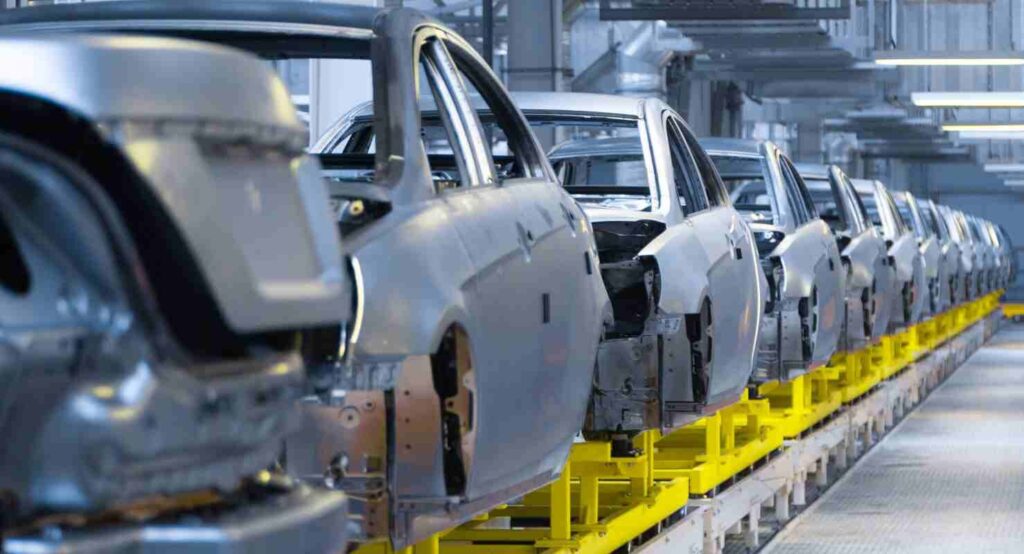
The automotive and transportation industry is one of the largest consumers of sheet metal fabrication. Every vehicle, whether a passenger car, commercial truck, or electric vehicle, depends on precisely cut and bent components for safety, performance, and design. Manufacturers face challenges like tighter tolerances, faster production cycles, and the need for lightweight yet durable parts. FormNCut® machines provide the technology to meet these demands with efficiency and reliability.
Laser Cutting Machines in Automotive
FormNCut Fiber Laser Cutting Machines, such as the Marut Series high‑power fiber lasers, are widely used in automotive manufacturing. These machines are designed to cut complex shapes and thick or thin sheets with unmatched accuracy.
- Body panels cutting – Fiber lasers produce clean, burr‑free cuts for car body panels. This reduces post‑processing work like grinding or polishing, saving time and cost.
- Chassis brackets – High‑strength steel brackets are cut with repeatability, ensuring every chassis assembly is consistent.
- Exhaust parts – Complex exhaust shapes are processed quickly, with smooth edges that improve airflow and reduce noise.
- Battery tray components – EV battery trays require corrosion‑free, burr‑free cutting. Fiber lasers deliver this consistently, ensuring safety and longevity.
- EV motor housings – Motor housing plates are cut with tight tolerances, improving assembly alignment and reducing vibration.
Advantages of Laser Cutting Machines
- High precision with minimal waste
- Faster production cycles compared to mechanical cutting
- Ability to cut complex geometries easily
- Clean edges reduce secondary finishing
- Reliable performance across different metals (steel, aluminium, copper)
Operational Process of Laser Cutting
- Sheet metal is loaded onto the cutting bed.
- CAD designs are programmed into the CNC controller.
- The fiber laser beam is focused through collimating and focusing lenses.
- Height sensors maintain consistent distance between nozzle and sheet.
- Assist gases (oxygen, nitrogen, or air) are regulated for clean cutting.
- Finished parts are unloaded, ready for assembly with minimal finishing.
Bending Machines in Automotive
FormNCut® CNC Press Brakes, including Hydraulic Servo Press Brakes and Panel Benders, are essential for shaping automotive components. These machines bend sheet metal into precise angles and complex forms required in modern vehicles.
- Bracket bending – Press brakes bend brackets for mounting mechanical and electrical parts.
- Automotive frame bending – Frames and supports are bent with precise angles, ensuring structural stability.
- Dashboard support structures – CNC bending produces complex dashboard frames quickly and accurately.
- Battery enclosure bending – EV battery boxes are bent with precision, ensuring proper sealing and safety
Advantages of Bending Machines
- Accurate angles and repeatable bends
- CNC control reduces operator error
- Ability to bend thick and thin sheets with equal precision
- Energy‑efficient servo systems reduce operating costs
- Strong, durable bends improve product safety and reliability
Operational Process of Bending
- Sheet metal is positioned using back gauges and sensors.
- CNC controller programs the bending sequence.
- Punch and die tooling apply force to bend the sheet.
- Crowning systems compensate for deflection, ensuring uniform bends.
- Servo motors deliver smooth, controlled movement.
- Finished parts are removed and inspected for accuracy.
The combination of clean laser cuts and accurate bends reduces waste, improves safety, and supports faster production cycles. Automotive manufacturers benefit from reliable technology that keeps them competitive in a fast‑changing industry.
