
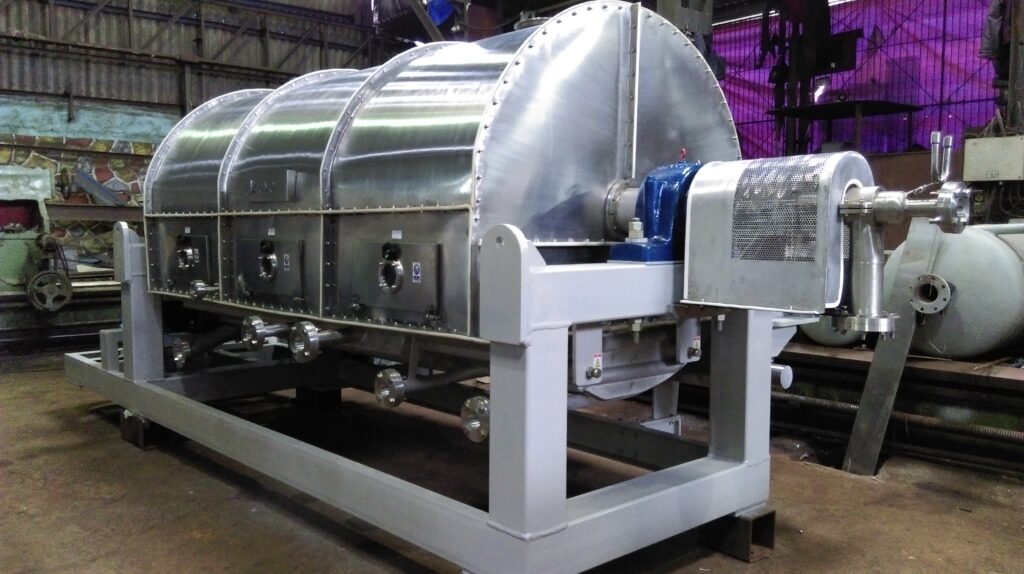
By Jyoti Process Equipment
Picture this. You have a product that’s molten at high temperatures, and your goal is to turn it into a neat, solid, easy-to-handle form. Maybe it’s a wax, a resin, a fatty acid, or a chemical compound. How do you do it efficiently, cleanly, and at scale? That’s exactly where a Drum Flaker steps in.
At Jyoti Process Equipment, we’ve built Drum Flakers that are reliable, versatile, and designed to handle continuous production without breaking a sweat. Let’s walk you through what makes them special… in plain, everyday language.
What Does a Drum Flaker Actually Do?
Simply put, a Drum Flaker takes a molten product and converts it into solid flakes — continuously, and without stopping your production line. Here’s how it works in a nutshell: your molten feed is applied onto the outer surface of a large rotating drum, either through a feed tray or an applicator roller. As the drum slowly rotates, the product cools down, solidifies on the drum surface, and is then scraped off as crisp, uniform flakes.
It’s a beautifully simple concept — and when it’s engineered well, it’s incredibly effective. The result? A consistent, solid product that’s easy to pack, store, handle, and transport.
The Engineering Behind It
One thing that often trips people up is the feed tray. Your molten material needs to stay liquid in the tray until it reaches the drum — otherwise it would solidify too early and clog everything up. To prevent this, the feed tray is equipped with a limpet coil or jacketed design that maintains the right temperature using steam, thermic fluid, or hot water. Smart, right?
Once the molten product reaches the drum, the cooling begins. The drum is internally cooled by spraying chilled or cooling water through spray nozzles inside. This controlled cooling is what gives you that clean, uniform solidification every single time.
To make sure the cooling water doesn’t leak out of the rotating drum, a PTFE rope or Mechanical Seal is provided at the rotary joint. It’s a small but critical detail that keeps the system clean and maintenance-friendly.
Once the product has solidified on the drum surface, a scraper blade gently removes it — and out come your flakes, ready for collection.
One Size Doesn’t Fit All
Different products. Different industries. Different requirements. That’s exactly why Jyoti Process Equipment offers Drum Flakers in multiple configurations. Whether you’re running a small-batch specialty chemical operation or a high-volume continuous production line, there’s a setup that fits your needs.
Feed Mechanism Options:
- Single Drum Flaker with Bottom Dip Feed — ideal for straightforward melt applications
- Single Drum Flaker with Bottom Applicator Roller — for better control over the feed thickness
- Single Drum Flaker with Overhead Applicator Roller — suited for specific product and process conditions
- Double Drum Flaker with Nip Feed — perfect for higher throughput and uniform flake thickness
Other configurations are also available upon request. Just tell us what your process demands, and we’ll engineer it to match.
Cooling Drum Sizes:
We offer drum sizes ranging from 0.5 Sq.Mtr to 30 Sq.Mtr — a wide range that covers everything from lab-scale trials to full industrial production. And if your process requires it, the cooling drum can even be chrome plated for added durability and surface performance.
The Scraper Blade – More Important Than You’d Think
The scraper blade is what separates (literally!) your solidified product from the drum surface. Getting this right matters — a poor scrape means product wastage, inconsistent flakes, or drum surface damage over time.
Jyoti offers three scraper blade operating options:
- Manual Hand Wheel — for precise manual control
- Pneumatic — for smooth and automated operation
- Hydraulic — for heavy-duty, high-torque applications
Blade material options are equally flexible:
Hylam, Phosphor Bronze, Magnesium Bronze, Brass, Food Grade Teflon — and others on request. The right blade material depends on your product chemistry and hygiene requirements, and our team will help you choose the best fit.
Product Collection – Clean, Flexible, and Practical
Once your flakes are ready, what happens next? You have options. The flakes can be collected through a product collection chute or hopper — or, if you need a more automated flow, they can be discharged via a lump breaker or screw conveyor directly into drums or bags. This flexibility means the Drum Flaker fits neatly into your existing production and packaging workflow without requiring major changes downstream.
Less handling, less manual labour, and a cleaner production floor — that’s what thoughtful engineering delivers.
Built for Your Industry’s Standards
We understand that different industries come with different compliance demands. That’s why Jyoti Process Equipment can manufacture Drum Flakers that are GMP compliant and Food Grade compliant — depending on your specific requirements. Whether you’re in pharmaceuticals, food processing, or specialty chemicals, you can count on an equipment standard that meets your regulatory needs.
Material of construction for all contact parts is available in Carbon Steel, SS 304, SS 316, SS 316L, and other materials on request. This ensures full chemical compatibility with whatever product you’re processing.
You get the right material, the right finish, and the right certification — all in one machine.
Why Choose Jyoti Process Equipment’s Drum Flaker?
Let’s quickly recap the reasons this is a product worth investing in:
- Continuous Operation: No batch cycles, no stoppage. Your production runs smoothly around the clock.
- Consistent Flake Quality: Uniform cooling and scraping means every flake meets the same quality standard.
- Versatile Feed Options: Multiple drum configurations to match your specific product and process.
- Customizable to Your Needs: From drum size and MOC to feed mechanism and blade type — it’s built around you.
- GMP & Food Grade Ready: Compliance-ready manufacturing for regulated industries.
- Easy Product Discharge: Multiple collection options keep your downstream operations moving efficiently.
- Durable and Low Maintenance: Robust construction with leak-proof rotary joints means less downtime and longer equipment life.
Ready to Flake It Right?
If your production process involves converting molten materials into solid form, the Drum Flaker from Jyoti Process Equipment is built for exactly that job. It’s reliable, efficient, and engineered to grow with your production needs.
Whether you’re just starting out or looking to upgrade your existing solidification process, our team is ready to understand your requirements and recommend the right configuration for you.
Get in touch with Jyoti Process Equipment today and let’s turn your molten challenge into a flake of perfection.