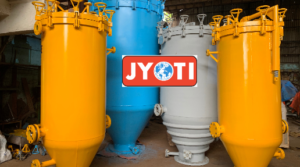
Pressure Leaf Filter
Q1: What is a Pressure Leaf Filter used for?
It is used to separate solids from liquids in industries like chemicals, food, and pharmaceuticals.
Q2: How does it work?
Liquid passes through filter leaves under pressure, forming a filter cake that traps impurities.
Q3: What are the types available?
Vertical and horizontal pressure leaf filters, chosen based on space and application.
Q4: How often should it be cleaned?
After each cycle or when pressure drop indicates clogging.
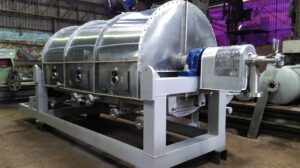
Drum Flaker
Q1: What does a Drum Flaker do?
It cools molten material on a rotating drum and converts it into solid flakes.
Q2: Where is it used?
In chemical, pharmaceutical, food, and agro industries for waxes, resins, and fatty acids.
Q3: What materials can it handle?
Heat-sensitive, sticky, or viscous materials.
Q4: What are its benefits?
Uniform flakes, energy efficiency, and easy handling.
Drum Dryer
Q1: What is a Drum Dryer?
It dries liquids, pastes, or slurries into powders or flakes using a heated rotating drum.
Q2: Which industries use it?
Food (milk powder, fruit pulp), chemicals, and pharmaceuticals.
Q3: How fast is the drying process?
Usually takes only a few seconds due to direct heat transfer.
Q4: Can it handle heat-sensitive materials?
Yes, vacuum drum dryers are designed for such applications.
Polishing Bag Filter
Q1: What is a Polishing Bag Filter?
It removes fine particles after main filtration for extra clarity.
Q2: Where is it used?
In chemical, pharma, and food industries for polishing liquids.
Q3: How is it maintained?
Bag filters are replaced or cleaned depending on contamination levels.
Q4: Why is it important?
It ensures high product purity and smooth downstream processes.
Reactor
Q1: What is a Reactor?
A vessel where chemical reactions are carried out under controlled conditions.
Q2: What types are available?
Batch, continuous stirred tank (CSTR), and plug-flow reactors.
Q3: What industries use reactors?
Pharmaceuticals, chemicals, petrochemicals, and food processing.
Q4: Why choose stainless steel reactors?
They are durable, corrosion-resistant, and easy to clean.
Candle Filter
Q1: What is a Candle Filter?
A pressure-driven system with vertical filter elements for solid-liquid separation.
Q2: How does it clean itself?
By backflushing with compressed air or liquid.
Q3: What industries use it?
Pharma, food, chemicals, and petrochemicals.
Q4: What are its advantages?
High precision, closed operation, and automated cleaning.
Heat Exchanger
Q1: What is a Heat Exchanger?
It transfers heat between two fluids without mixing them.
Q2: What types are common?
Shell-and-tube, plate-and-frame, and finned-tube exchangers.
Q3: Where is it used?
HVAC, chemical plants, power stations, and food processing.
Q4: Why is it important?
It improves energy efficiency and reduces operating costs.